
The Intellectual Origins of DID: From the Cholera Map to Causal Inference
Tracing the historical lineage of difference-in-differences—from John Snow's London cholera study in the 19th century to a cornerstone of modern econometrics, and understanding how the core idea of DID was born.
Structure of This Article
- Origins: 19th-century London cholera and John Snow's insight
- Breakthrough: The prototype of natural experiments—the London water supply reform
- Legacy: The academic lineage from Snow to modern DID
- Current Status: DID's dominant position in contemporary economic research
Layer 1: Intellectual Origins
The Intuition of Difference-in-Differences—A Study That Saved Tens of Millions of Lives
In the 19th century, London was ravaged by cholera, with tens of thousands dying while the medical establishment was helpless.
- The vast majority (including Snow himself initially) believed in the "miasma theory", holding that disease spread through tiny toxic particles in the air.
- Despite air-targeted preventive measures (such as isolating patients, even covering them with coarse burlap sacks), cholera remained rampant, prompting Snow to begin questioning the prevailing theory.
As early as 1855, Snow's study of cholera in London began applying comparative thinking.
The Observation Stage
Snow uncovered several critical clues:
- Sailors fell ill only after coming ashore to take on supplies;
- In two adjacent apartment buildings, one had severe infections while the other did not—the difference being that the former's water supply was contaminated by sewage, while the latter's was cleaner.
From this he proposed a new hypothesis: cholera was caused by a living organism entering the human body through the digestive tract, i.e., transmitted through contaminated food or drinking water.
The Broad Street Cholera Map
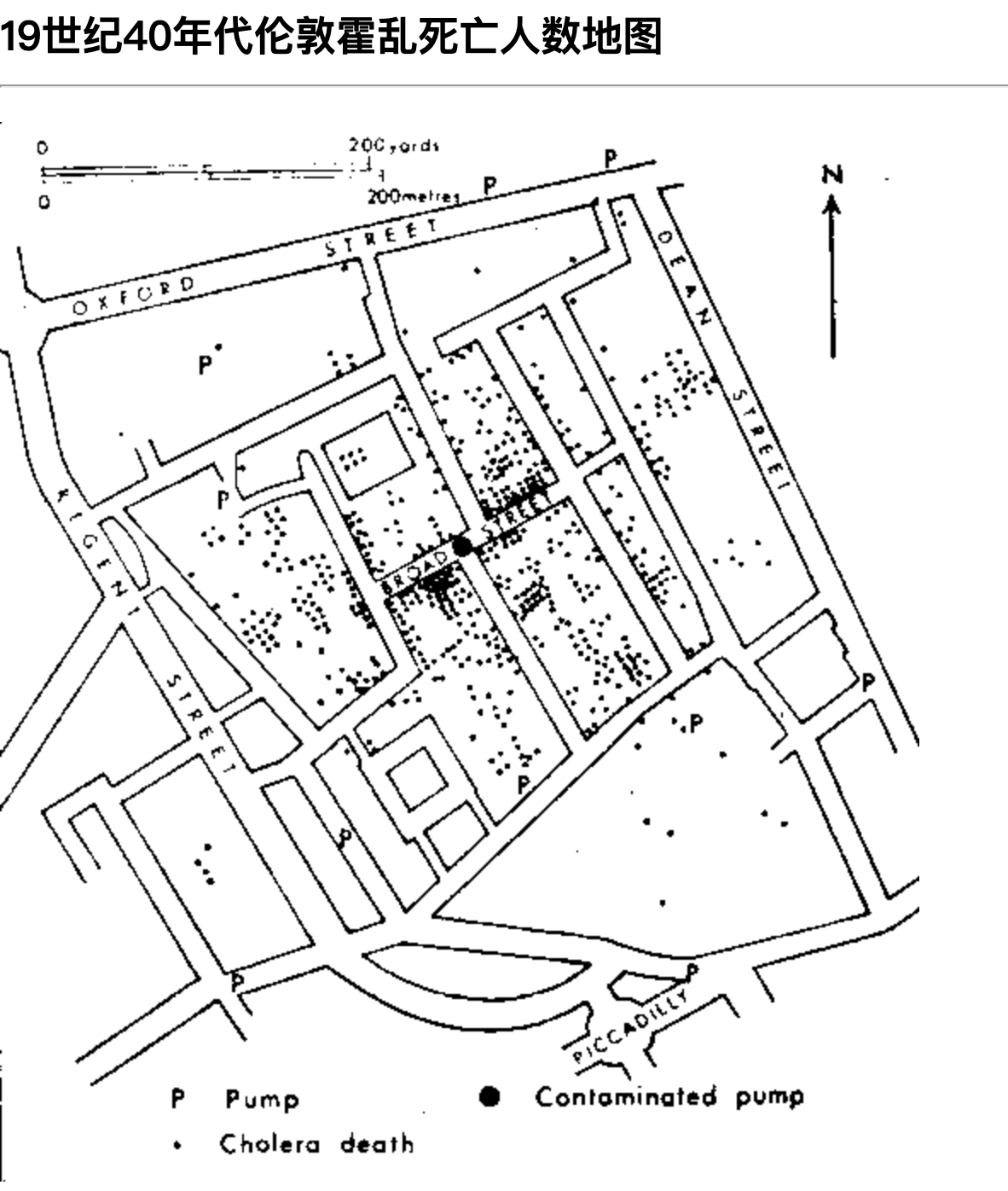
This famous map, drawn by British physician John Snow during his cholera epidemiological research in London in the late 1840s, is often called the "Broad Street cholera map". It is regarded as one of the foundational works of modern epidemiology and spatial data analysis.
Map legend:
- Black dots: Locations of cholera deaths
- Letter P: Marks the location of water pumps
- Large black dot: The contaminated pump, namely the Broad Street pump, the core source of transmission in this outbreak
- Small squares or symbols: Buildings or housing units
Spatial Distribution of Deaths
- Each dot represents one death
- Highly concentrated around the Broad Street Pump
- Forming a dense cluster of deaths centered on the pump
- The highest number of deaths was in a residential area directly in front of the pump (later identified as near "No. 6 Broad Street")
Layer 2: The Key Breakthrough in Causal Inference
The Problem: Limitations of Observation
Observation alone could not fully rule out other factors such as poverty and sanitation conditions. Snow needed more compelling evidence to establish a causal relationship.
The ideal scenario: Snow would flip a coin to randomly decide who drank contaminated water and who drank clean water, then compare mortality rates.
However, such physical randomization is neither practical nor ethical in reality. Social scientists need to find scenarios in the real world where randomization-like conditions occur naturally.
The Key Breakthrough: The 1854 London Water Supply Reform
- To obtain cleaner water, the Lambeth Company moved its intake point upstream on the Thames (away from the sewage discharge points downstream);
- The Southwark and Vauxhall Company, however, maintained the status quo, continuing to draw water from the contaminated downstream intake.
Snow found that the neighborhoods and populations served by the two companies were very similar in observable characteristics such as poverty levels and sanitation practices.
The only difference: one company changed, the other did not.

This Is the Core Logic of DID
Compare the differences in changes before and after a policy/event between two groups, thereby isolating the true effect of the policy.
Although Snow's study did not use the term "difference-in-differences," he had already grasped its core idea: find two comparable groups, observe that one receives the "treatment" while the other does not, and then compare their changes.
Layer 3: From Snow to Modern DID
The Academic Lineage
| Time | Figure/Event | Contribution |
|---|---|---|
| 1854 | John Snow | London cholera study, prototype of natural experiments |
| 1984 | Ashenfelter & Card | Princeton University, foundational work that systematically applied and popularized DID in modern econometrics |
| 2005 | Zhou Li'an, Chen Ye | Chinese scholars who first used the DID model to systematically evaluate the effects of rural tax and fee reform in China |
DID in Contemporary Use
Statistics on methods used in NBER (working papers) show that DID has become one of the most frequently used methods in the field of causal inference.
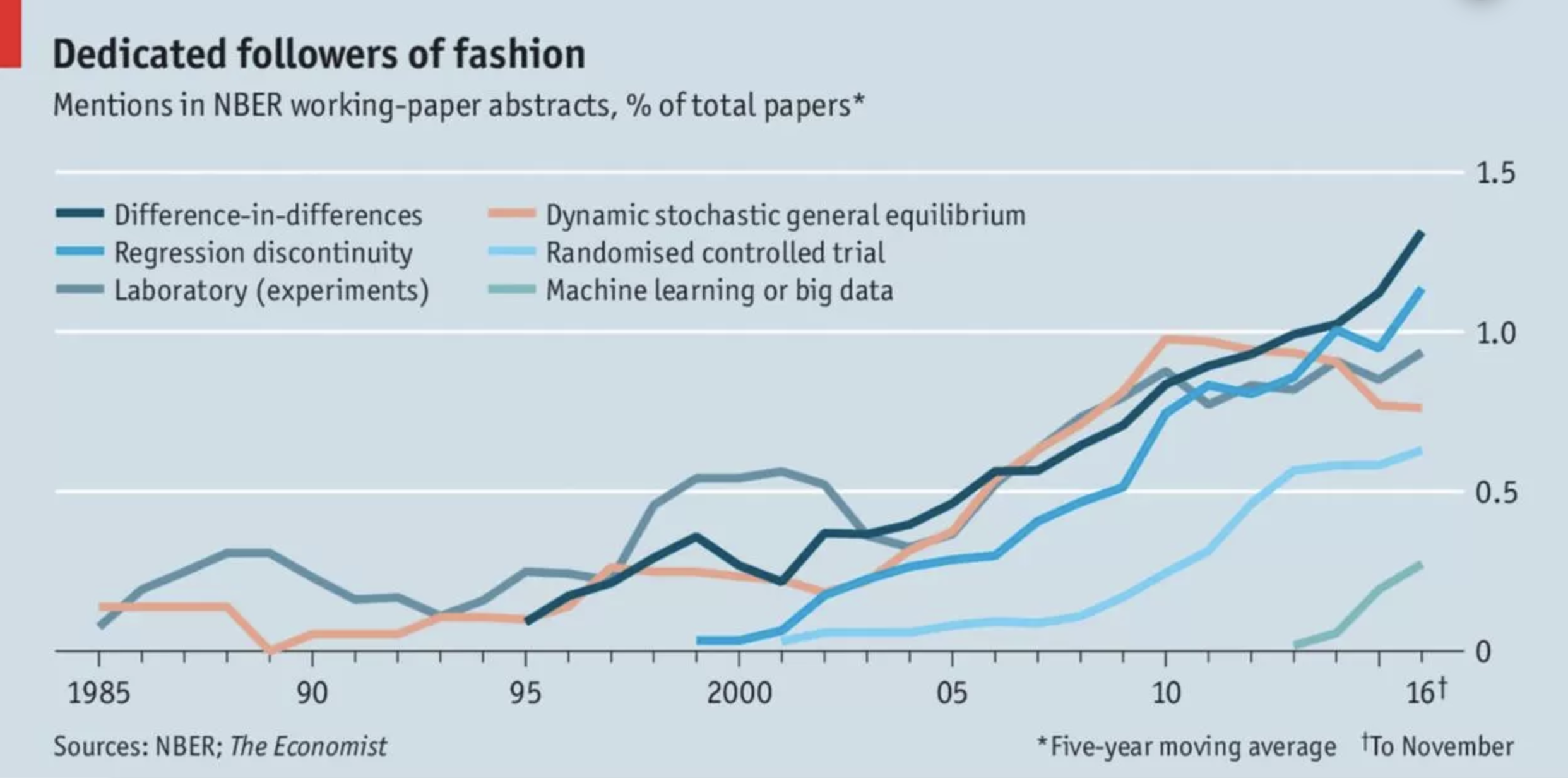
Source: Huang Wei, Zhang Ziyao, Liu Anran. From Difference-in-Differences to Event Study[J]. Industrial Economics Review, 2022, (02): 17-36.
DID in Top Chinese Journals
Among articles published between 2019 and 2021 in Economic Research Journal, Management World, China Economic Quarterly, The Journal of World Economy, and China Economic Review, a search for keywords such as "difference-in-differences," "double difference," "two-way fixed effects," and "event study" identified 473 articles that primarily employed TWFE regression methods.
Of these, 119 articles did not involve a causal inference framework and were classified into the "other" category.
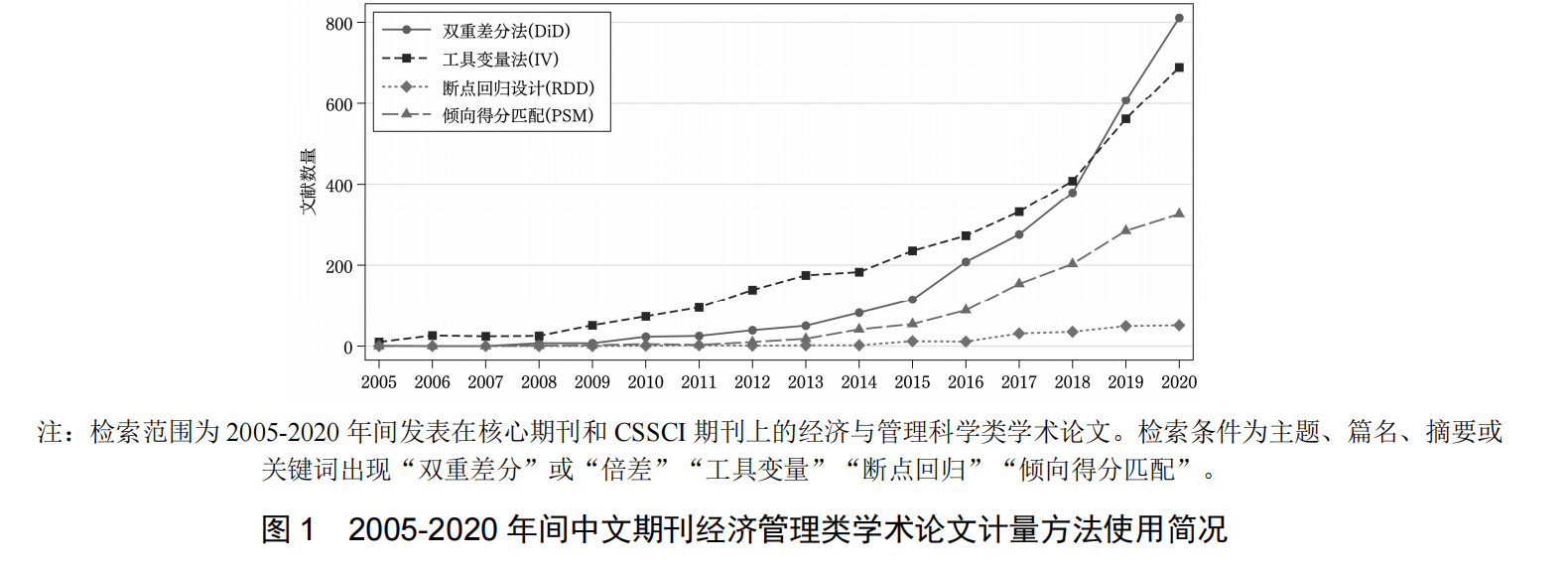
Lin Mengyun, Xu Yang, Guo Rufei, et al. Understanding the Latest Developments in Difference-in-Differences Methods under a Unified Framework of Model Misspecification[J]. Management World, 2025, 41(06): 227-264.
Core Takeaways
- The essence of DID is not a complex statistical technique but a logic of causal inference—finding near-randomized scenarios through natural experiments.
- Snow's contribution lies not only in discovering the transmission route of cholera but also in demonstrating how to approach causality from observational data using comparative thinking.
- The flourishing of modern DID: From Ashenfelter & Card (1984) to today, DID has become one of the most mainstream methods in empirical economics.
Next Steps
- Classic 2×2 Difference-in-Differences: Systematically learn the model specification, estimation, and inference of DID
- Parallel Trends Assumption: Understand the core identification assumption of DID
- Event Study: Visualization and analysis of dynamic treatment effects
References
- Snow, J. (1855). On the Mode of Communication of Cholera. London: John Churchill.
- Ashenfelter, O., & Card, D. (1984). Using the Longitudinal Structure of Earnings to Estimate the Effect of Training Programs. Review of Economics and Statistics, 67(4), 648-660.
- Zhou Li'an, Chen Ye. (2005). The Policy Effects of China's Rural Tax and Fee Reform: Estimates Based on a Difference-in-Differences Model. Economic Research Journal, (8), 42-53.
- Huang Wei, Zhang Ziyao, Liu Anran. (2022). From Difference-in-Differences to Event Study. Industrial Economics Review, (2), 17-36.
- Lin Mengyun, Xu Yang, Guo Rufei, et al. (2025). Understanding the Latest Developments in Difference-in-Differences Methods under a Unified Framework of Model Misspecification. Management World, 41(6), 227-264.
Related reading
- Classic 2×2 Difference-in-Differences (DID): Model Specification, Estimation, and Inference
A systematic introduction to the classic difference-in-differences method, two-way fixed effects estimation, clustered standard error selection, with complete Stata code.
DID思想起源之后,落到经典 2×2 公式(0 次访问)。 - Event Study: Dynamic Effect Estimation and Coefficient Plots
A comprehensive guide to the event study method, covering dynamic effect estimation, coefficient plot construction, normalization, and Leads/Lags settings.
DID起源故事之后看现在最常用的事件研究(31 次访问)。 - Parallel Trends Assumption: Intuition, Testing, and Visualization
An in-depth understanding of the core assumption of DID—parallel trends. Explains the meaning of the assumption, visualization testing methods, and pre-trend tests, with accompanying Stata code.
DIDDID 能用的关键假设(17 次访问)。 - Staggered DID: TWFE Bias and New Estimators (CS/SA/BJS)
An in-depth explanation of TWFE bias in staggered DID designs, introducing the principles and practical implementation of three new estimators: Callaway-Sant'Anna, Sun-Abraham, and Borusyak-Jaravel-Spiess.
DID - Why Do We Need Causal Inference? Three Sources of Endogeneity
An in-depth explanation of the three sources of endogeneity—omitted variable bias (OVB), reverse causality, and measurement error—and when OLS fails. Simulated data are used to intuitively demonstrate the necessity of causal inference.
Causal Inference